Categories
Biology Covid-19 human body

SARS-CoV-2 Variants Develop in Chronic, Immunosuppressed Patients

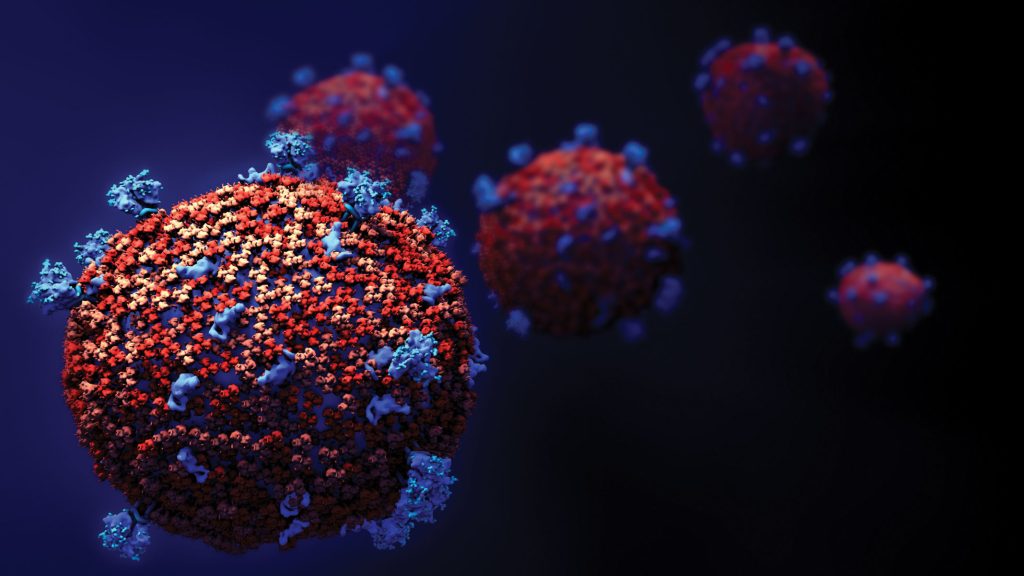
SARS-CoV-2 variants have been a key player in the conversation, and public health response, of the COVID-19 pandemic. But where do COVID-19 variants originate? Now, new research reveals that the many SARS-CoV-2 variants are likely formed in chronic COVID-19 patients who suffer from immunosuppression. The research suggests that a weakened antibody response, particularly in the lower airways of these chronic patients, may prevent full recovery from the virus and drive the virus to mutate many times during a lengthy infection. The virus’ ability to survive and reproduce in the immunosuppressed patient’s body—without restriction—leads to the evolution of many variants.

Furthermore, the variants found among those chronically ill with COVID-19 bear many of the same mutations in their evolution as those present in variants-of-concern (VOC) for severe illness—particularly those mutations associated with evading antibodies. The new findings indicate that while rapidly-spreading variants are rare among the many strains borne from immunosuppressed patients, the likelihood increases and they do arise when global infection rates boom.

Since the start of COVID-19, the rate at which the virus evolves has been somewhat puzzling to Adi Stern, PhD, professor of biotechnology at the Shmunis School of Biomedicine and Cancer Research at the Wise Faculty of Life Sciences at Tel Aviv University. During the first year of the pandemic, a relatively slow but constant rate of mutations was observed. However, since the end of 2020, the world has witnessed the emergence of variants that are characterized by a large number of mutations, far exceeding the rate observed during the first year. Various scientific hypotheses about the link between chronic COVID-19 patients and the rate of the accumulation of mutations have surfaced, but nothing definitive has been proven.

“The coronavirus,” noted Stern, “is characterized by the fact that in every population, there are people who become chronically infected. In the case of these patients, the virus remains in their body for a lengthy period of time, and they are at high risk for recurrent infection. In all of the cases observed so far, these were immunocompromised patients. In biological evolutionary terms, these patients constitute an “incubator” for viruses and mutations—the virus persists in their body for a long time and succeeds in adapting to the immune system, by accumulating various mutations.”

The study searched for drivers of VOC-like emergence by consolidating sequencing results from a set of 27 chronic infections in patients at the Tel Aviv Sourasky Medical Center.

According to Stern, the results reveal a complex picture; although no direct connection was found between anti-COVID-19 drug treatment and the development of variants, the researchers discovered that it is likely the weakened immune system of immunocompromised patients that creates pressure for the virus to mutate.

Most substitutions in this set, the authors noted, reflected lineage-defining VOC mutations; however, a subset of mutations associated with successful global transmission was absent from chronic infections.

In fact, the researchers found that there were chronic patients who showed a pattern of apparent recovery, followed by recurring viral infection. In all of these patients, a mutated form of the virus emerged, suggesting that recovery had not been achieved; this is partially reminiscent of HIV following inadequate drug treatment.

Upon closer examination of some patients, the researchers found that when such a pattern of apparent recovery is observed (based on negative nasopharyngeal swabs), the virus continues to thrive in the lungs of the patients. The researchers, therefore, suggest that the virus accumulates mutations in the lungs, and then traverses back to the upper respiratory tract.

The authors believe that they found evidence for dynamic polymorphic viral populations in most patients, suggesting that a compromised immune system selects for antibody evasion in particular niches in a patient’s body. In addition, there is a tradeoff between antibody evasion and transmissibility and that extensive monitoring of chronic infections is necessary to further understanding of VOC emergence
Categories
Covid-19 environment

CO2 Emissions bounce back!!

A new report by multiple international scientific agencies has flagged that fossil fuel emissions from coal, gas cement etc are back to 2019 levels or even higher in 2021.

Fossil CO2 emissions from coal, oil, gas and cement – peaked at 36.64 GtCO2 in 2019, followed by a significant drop of 1.98 GtCO2 (5.6%) in 2020 due to the Covid-19 pandemic.

Based on preliminary estimates, global emissions in the power and industry sectors were already at the same level or higher in January-July 2021 than in the same period in 2019, before the pandemic, highlights of the United in Science report said on Thursday.

United in Science is coordinated by the World Meteorological Organization (WMO), with input from the UN Environment Programme (UNEP), the World Health Organization (WHO), the Intergovernmental Panel on Climate Change (IPCC), the Global Carbon Project (GCP) etc. The full report will be released later today.

While emissions from road transport remained about 5% lower. Apart from aviation and sea transport, global emissions were at about the same levels as in 2019, averaged across those 7 months.

Concentrations of all major greenhouse gases – carbon dioxide (CO2), methane (CH4) and nitrous oxide (NO) continued to increase in 2020 and the first half of 2021, the report said, adding that overall emissions reductions in 2020 likely reduced the annual increase of the atmospheric concentrations of greenhouse gases “but this effect was too small to be distinguished from natural variability.”

United in Science has reiterated that there is high chance that global average temperature in one of the next five years will be at least 1.5 degrees Celsius (°C) higher than pre-industrial levels. Annual global mean near-surface temperature is likely to be within the range 0.9°C to 1.8°C in the next five years. There is a 40% chance that average global temperature in one of the next five years will be at least 1.5°C warmer than pre-industrial levels but it is very unlikely (~10%) that the 5-year mean temperature for 2021–2025 will be 1.5°C warmer.

The report has also flagged that coastal cities around the world; low lying coastal areas, small islands and deltas will need adaptation strategies urgently. Global mean sea levels rose 20 cm from 1900 to 2018 and at an accelerated rate of 3.7+0.5 mm/yr from 2006 to 2018. Even if emissions are reduced to limit warming to well below 2°C, global mean sea level would likely rise by 0.3–0.6 m by 2100. “Adaptation to this residual rise will be essential – adaptation strategies are needed where they do not exist – especially in low-lying coasts, small islands, deltas and coastal cities,” the report has said.

“Throughout the pandemic we have heard that we must build back better to set humanity on a more sustainable path and to avoid the worst impacts of climate change on society and economies. This report shows that so far in 2021 we are not going in the right direction,” said WMO Secretary-General Petteri Taalas.

This report shows just how far off course we are. The past five-year period is among the hottest on record. We continue to destroy the things on which we depend for life on Earth. Ice caps and glaciers continue to melt, sea-level rise is accelerating, the ocean is dying and biodiversity is collapsing. This year, fossil fuel emissions have bounced back to pre-pandemic levels. Greenhouse gas concentrations continue to rise to new record highs. We now have five times the number of recorded weather disasters than we had in 1970 and they are seven times more costly. Even the most developed countries have become vulnerable,” said UN Secretary-General, António Guterres on the launch of the report.

He added that UN climate negotiations (COP26) this November must mark that turning point. “By then we need all countries to commit to achieve net zero emissions by the middle of this century and to present clear, credible long-term strategies to get there. We need all countries to present more ambitious and achievable Nationally Determined Contributions that will together cut global greenhouse gas emissions by 45% by 2030, compared to 2010 levels. Nothing less will do.”

Guterres, and UK Prime Minister Boris Johnson have called an informal, closed-door roundtable with a small but representative group of heads of state and government, on the sidelines of the General Assembly, on Monday September 20. The Informal Climate Leaders Roundtable on Climate Action follows the recent report of the Intergovernmental Panel on Climate Change and comes less than six weeks before the COP26 Climate Change Conference in Glasgow.

IPCC’s report last month had flagged that the world may have lost the opportunity to keep global warming under 1.5°C over pre-industrial levels. The 1.5°C global warming threshold is likely to be breached in the next 10 to 20 years by 2040 in all emission scenarios including the one where carbon dioxide (CO2) emissions decline rapidly to net zero around 2050.

According to senior officials in the UN, the focus of the meeting will be a road map for the 1.5°C goal; climate mitigation and adaptation finance particularly the commitment to mobilise $100 billion per year by 2020 by developed countries.

Categories
environment

World Environment Day 2021

Happy environment day folks!!

Every year on June 5 Wold Environment Day 2021 is celebrated to spread awareness among people to conserve the environment for a healthy and better future. This day was created by United Nations in 1974 to create awareness regarding the need to protect our surroundings. 

In a wake to go digitalize, we have forgotten that our mother nature is vulnerable to technologies that are harming the environment. It is essential to save and rebuild the relationship with nature, as the environment is made up of every living and non-living beings. Also known as Eco Day or Environment Day, people on this day, organize various events in schools, colleges and offices. The aim to organize exhibition, conference and events is to encourage people to plant more trees and give tips to save the environment. World Environment Day 2021 theme is “Ecosystem Restoration”, and the global host of this campaign will be Pakistan.

For too long, humans have been exploiting and destroying the planet’s ecosystems. Every three seconds, the world loses enough forest to cover a football pitch and over the last century, we have destroyed half of the wetlands. As much as 50 per cent of the world’s coral reefs have already been lost and up to 90 per cent of coral reefs could be lost by 2050, even if global warming is limited to an increase of 1.5 degrees Celsius. Ecosystem loss is depriving the world of carbon sinks, like forests and wetlands, at a time when humanity can least afford it. Global greenhouse gas emissions have grown for three consecutive years and the planet is one place for potentially catastrophic climate change. We must now fundamentally rethink our relationship with the living world, with natural ecosystems and their biodiversity and work towards its restoration.

I was pondering about what I should do as a concerned world citizen on environment day amidst this pandemic. Browsing through the internet I got a bunch of ideas to make environment day 2021 fun-filled and productive by staying at home. I couldn’t stop myself from sharing these ideas with you. So, let’s get straight to it!

1) Watch a documentary

Watching a documentary is one of the best ways to learn about our environment and making sustainable choices to ensure a safe and healthy future for generations to come. Here are some of the documentaries that you can line-up for viewing — Pacificum: Return to the Ocean(Netflix), Cowspiracy(Netflix), The 11th Hour (YouTube) among many others.  

2) Take a virtual garden or museum tour 

With many of us staying indoors, WED is a great day to start having an environment-related conversation with your kids and teach them about the preservation of natural resources. You can do fun garden activities with them or take them on the virtual gardenzoo or museum visits available online.   

3) Shift to reusable water bottles and straws

Plastic straws have been a big menace to the oceans. Get on board to ditch them this WED and invest in cleaner and recyclable options such as paper, bamboo or metal straws and BPA-free, glass, stainless steel or copper bottles.    

4) Start a new sustainable diet 

Our meals can leave a huge carbon footprint if they are not sourced in environment-friendly ways. To contribute to combating this issue, you can start a new diet at home or make amends in your catering policy by switching to seasonal, sustainable and local plant-based products. Vegan, vegetarian and eco-friendly Keto diets are examples of some carbon-cutting options that involve giving up animal-based foods entirely.    

5) Ditch the single-use plastic containers at home

Around 40 percent of the plastic used in the world is single-use. It will be environment-friendly to phase out the containers made of single-use plastic at your home and swap them for cleaner and sustainable alternatives such as reusable glass containers, stainless steel lunch boxes and mason jars.     

I have adopted these amazing ideas and would encourage you to do the same!

Let us celebrate the occasion of World Environment Day by working together to save our planet from everything that harms it!!

Happy world environment day!!

Design a site like this with WordPress.com
Get started