Categories
environment

The ocean and climate change

  • The ocean is being disproportionately impacted by increasing carbon dioxide (CO2) and other greenhouse gas emissions (GHG) from human activities.
  • This causes changes in water temperature, ocean acidification and deoxygenation, leading to changes in oceanic circulation and chemistryrising sea levelsincreased storm intensity, as well as changes in the diversity and abundance of marine species.
  • Degradation of coastal and marine ecosystems threatens the physical, economic and food security of local communities, as well as resources for global businesses.
  • Climate change weakens the ability of the ocean and coasts to provide critical ecosystem services such as food, carbon storage, oxygen generation, as well as to support nature-based solutions to climate change adaptation.
  • The sustainable management, conservation and restoration of coastal and marine ecosystems are vital to support the continued provision of ecosystem services on which people depend. A low carbon emissions trajectory is indispensable to preserve the health of the ocean.

What is the issue ?

At the front line of climate change, the ocean, the coastlines and coastal communities are being disproportionately impacted by increasing carbon dioxide (CO2) and other greenhouse gas (GHG) emissions from human activities.

The ocean plays a central role in regulating the Earth’s climate. The Fifth Assessment Report published by the Intergovernmental Panel on Climate Change (IPCC) in 2013 revealed that it has thus far absorbed 93% of the extra energy from the enhanced greenhouse effect, with warming now being observed at depths of 1,000 m. As a consequence, this has led to increased ocean stratification (prevention of water mixing due to different properties of water masses), changes in ocean current regimes, and expansion of depleted oxygen zones. Changes in the geographical ranges of marine species and shifts in growing seasons, as well as in the diversity and abundance of species communities are now being observed. At the same time, weather patterns are changing, with extreme events increasing in frequency.

Atmospheric warming is leading to the melting of inland glaciers and ice, causing rising sea levels with significant impacts on shorelines (coastal erosion, saltwater intrusion, habitat destruction) and coastal human settlements. The IPCC projects global mean sea level to increase by 0.40 [0.26–0.55] m for 2081–2100 compared with 1986–2005 for a low emission scenario, and by 0.63 [0.45–0.82] m for a high emission scenario. Extreme El Niño events are predicted to increase in frequency due to rising GHG emissions.

CO2 emissions are also making the ocean more acidic, making many marine species and ecosystems increasingly vulnerable. Ocean acidification reduces the ability of marine organisms, such as corals, plankton and shellfish, to build their shells and skeletal structures. It also exacerbates existing physiological stresses (such as impeded respiration and reproduction) and reduces growth and survival rates during the early life stages of some species. 

Why is it important ?

The ocean and coasts provide critical ecosystem services such as carbon storage, oxygen generation, food and income generation.

Coastal ecosystems like mangroves, salt marshes and seagrasses play a vital role in carbon storage and sequestration. Per unit of area, they sequester carbon faster and far more efficiently than terrestrial forests. When these ecosystems are degraded, lost or converted, massive amounts of CO2 – an estimated 0.15-1.02 billion tons every year – are released into the atmosphere or ocean, accounting for up to 19% of global carbon emissions from deforestation. The ecosystem services such as flood and storm protection that they provide are also lost.

The impacts of ocean warming and acidification on coastal and marine species and ecosystems are already observable. For example, the current amount of CO2 in the atmosphere is already too high for coral reefs to thrive, putting at risk food provision, flood protection and other services corals provide. Moreover, increased GHG emissions exacerbate the impact of already existing stressors on coastal and marine environments from land-based activities (e.g. urban discharges, agricultural runoff and plastic waste) and the ongoing, unsustainable exploitation of these systems (e.g. overfishing, deep-sea mining and coastal development). These cumulative impacts weaken the ability of the ocean and coasts to continue to perform critical ecosystem services.

The degradation of coastal and marine ecosystems threatens the physical, economic and food security of coastal communities – around 40% of the world population. Local fishers, indigenous and other coastal communities, international business organisations and the tourism industry are already seeing the effects of climate change particularly in Small Island Developing States (SIDS) and many of the Least Developed Countries (LDCs).

Weakened or even lost ecosystems increase human vulnerability in the face of climate change and undermine the ability of countries to implement climate change adaptation and disaster risk reduction measures, including those provided for in Nationally Determined Contributions (NDCs) under the Paris Agreement on climate change.

back to top

What can be done?

The sustainable management, conservation and restoration of coastal and marine ecosystems are vital to support the continued provision of carbon sequestration and other ecosystem services on which people depend.

Marine Protected Areas (MPAs) for example can protect ecologically and biologically significant marine habitats, including regulating human activities to prevent environmental degradation. At the IUCN World Conservation Congress 2016, IUCN Members approved a resolution calling for the protection of 30% of the planet’s ocean by 2030.

Protection and restoration of coastal ecosystems is also needed. Policies to prevent the conversion of these ecosystems to other land uses, for example regulating coastal development, can ensure their protection.

Countries can also develop policies and ensure the implementation of sustainable practices in all industries that impact the ocean and coasts, including fisheries and the tourism industry.

Support for scientific research is needed. This will ensure the continued monitoring and analyses of the impacts of climate change, with the knowledge gained used to design and implement adequate and appropriate mitigation and adaptation strategies.

Globally ambitious efforts are also needed to reduce the use of fossil fuels, increase the use of renewable energy systems and enhance energy efficiency. This will reduce the impacts of CO2 and other GHGs on the ocean.

The key is to harness existing opportunities, by, for example, conserving certain coastal carbon ecosystems under the reducing emissions from deforestation and forest degradation (REDD+) mechanism, as well as implementing the Nationally Determined Contributions (NDCs) under the Paris Agreement. 

Ocean regulating the earth climate
Categories
environment

Human activity is slowly killing the world’s rivers, study illustrates

The rivers criss-crossing Earth are choking up and anthropogenic factors were found to be one of the prominent reasons, according to a new report. Agriculture, mining and dam construction emerged as some of the biggest contributors to this degradation.

The chemical composition of major rivers such as Yangtze, Amazon, Mississippi and Congo have been altered by natural and human activities, the study found. 

Historical data analysis of  runoff and solute concentration of 149 large rivers pointed out that higher volumes of calcium, potassium, chloride and bicarbonates are flowing through river basins and estuaries. 

The concentration of total dissolved solids draining into oceans increased 68 per cent, chloride 81 per cent, sodium 86 per cent and sulfate (142 per cent) fluxes in almost a decade, according to the report published in Nature Communications journal October 12, 2021. 

An international cohort of scientists from universities in China, the United States and the United Kingdom created a database of solute contents (some records maintained over a century) and analysed the same for almost 10 years. 

The rivers observed included the Colorado and Mississippi (USA), the Amazon (South America), the Congo (Africa), the Rhine (Europe), the Yellow and Yangtse rivers (China) and the Murray (Australia).

The polar and tropical regions were the worst-affected because most of the urbanisation and agriculture were concentrated there. Weathering of rocks are also contributing factors. 

These human activities, along with natural factors, cause seven river syndromes — salinisation, mineralisation, desalinisation, acidification, alkalisation, hardening and softening — that damage ecosystems. 

“Acidification was also observed close to the equator as a result of bicarbonate levels vital for river health being present in the rivers of South America,” the researchers wrote in the report. 

About 6,400 million tonnes of solutes reach the sea from rivers each year, the report stated. 

It called for urgent mitigation measures to prevent solute concetrations from exceeding critical levels.

Categories
Covid-19 environment

Let’s go BLUE for a COVID-19 recovery!!

“The ocean economy may be a victim of the impacts of the COVID-19 crisis, but it also holds solutions for rebuilding a more resilient, sustainable and equitable post-COVID world.”

– A Sustainable & Equitable Blue Recovery to the COVID-19 Crisis Report

Ocean and coastal habitats provide an essential workplace for the world’s small-scale fishers, and coastal communities rely on the ocean for jobs, food, health, and cultural traditions. In fact, the ocean economy adds approximately US$1.5 trillion in value globally (OECD 2016). But the COVID-19 pandemic disproportionally impacts the ocean economy and these communities, especially those from Small Island Developing States (SIDS).

new special report commissioned by the High-Level Panel for a Sustainable Ocean Economy (the Ocean Panel) recognizes the ocean economy’s vital role and the pandemic’s devastating impacts on ocean workers and the marine sector—and importantly, offers recovery solutions.

“A Sustainable and Equitable Blue Recovery to the COVID-19 Crisis”, as the name implies, recognizes the power of nature to help solve daunting global issues like climate change and pandemics. The report was released ahead of Climate Week NYC and a Rare-facilitated high-level roundtable meeting of coastal countries, where officials issued a joint message acknowledging the importance of the small-scale fishing sector to a blue (or green) recovery: that by implementing coastal and marine nature-based solutions, small-scale fishers can improve food security, nutrition, and the local economies of coastal nations, and enhance coastal resilience from climate change.

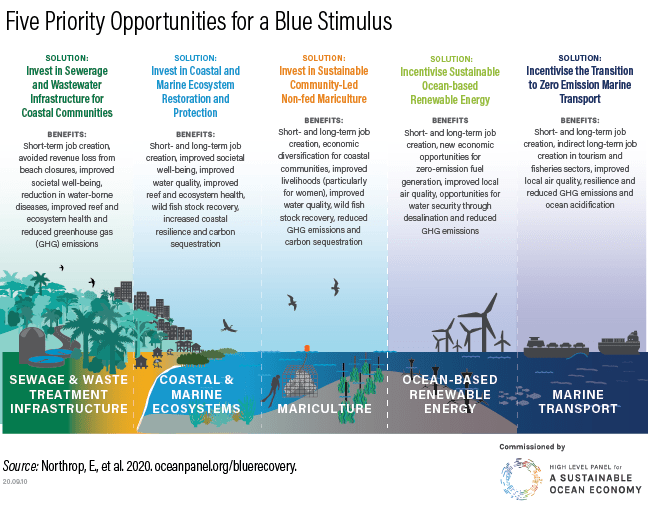
As a member of the Ocean Panel’s Advisory Network, Rare supports the five blue stimulus opportunities for government investment in COVID-19 crisis recovery outlined in the report. These proposed solutions deliver short-term relief to the economy and long-term economic, social, and environmental resilience. Moreover, they are considered a win-win for immediate assistance and forward-looking sustainable planning, known as a ‘no regrets’ investment strategy.

Fish Forever, Rare’s coastal fisheries program, prioritizes the report’s solution related to coastal and marine ecosystems: Invest in Coastal and Marine Ecosystem Restoration and Protection. Fish Forever uses behavioral insights to inspire fishing communities — fishers, fish buyers and traders, community members, and their local government — to adopt more responsible behaviors related to coastal fishing and implement nature-based solutions to protect their natural resources.

Investing in a nature-based solution like restoring and protecting coastal and marine ecosystems benefits coastal fishing households and their communities. This solution also has a host of benefits critical for a blue recovery, including the following five:

  1. Improves Food Security – Protecting coastal ecosystems supports ample fish resources and fish breeding habitat, which safeguards fishing communities by strengthening food security during times of crisis. Technology innovations, like Rare’s OurFish App referenced in the report, show how a nature-based approach to resource management benefits the community and improves food security: the app digitally helps to manage and understand fish stock and finance trends and enables fishing communities to monitor the value, type and local amount of fish caught.
  2. Enables Sound Financial and Household Decision-Making – Establishing Savings Clubs led by small-scale fishers empowers its members, often majority women, to manage their long-term household finances. It also raises awareness of the actions needed to enforce fish sanctuaries for coastal habitat protection and community livelihoods’ sustainability. This approach to behavior change “can powerfully affect the long-term strategy behind coastal fisheries conservation and the goal of ending overfishing,” as the report explains.
  3. Enhances Economic, Social, and Environmental Resilience – Investing in coastal and marine ecosystem restoration and protection can also expand job opportunities, such as protected areas enforcement officers, development planners, environmental engineers, and ecological restoration scientists. In addition to job security, nature-based solutions support the healthy natural resources that protect small-scale fishers’ livelihoods.
  4. Manages Natural Resources Sustainably – Ensuring coastal and marine ecosystem integrity further increases economic productivity by improving fisheries and tourism opportunities. Sustainable management also allows for more significant investment opportunities in blue carbon activities focused on climate mitigation and adaptation benefits from mangroves, seagrasses, and tidal salt marshes.
  5. Builds Community Pride – Stakeholder engagement and collaboration with public and private sectors, including small-scale fishers and their families, are critical for building pride in and ownership of more sustainable behaviors and community-based programs. Co-owning and managing natural resources and ensuring the inclusion of women and Indigenous communities has also demonstrated long-lasting benefits and delivers on many of the UN’s sustainable development goals.

Farmers and fishers rely on healthy ecosystems and strong local governance and management to thrive. Building back better from the impacts of COVID-19 will require a global blue recovery effort that not only prioritizes nature-based solutions but empowers coastal communities and their leaders to champion blue solutions.

BLUE solutions for COVID-19 recovery

Design a site like this with WordPress.com
Get started