
Categories
environment

Pakistan floods & climate change

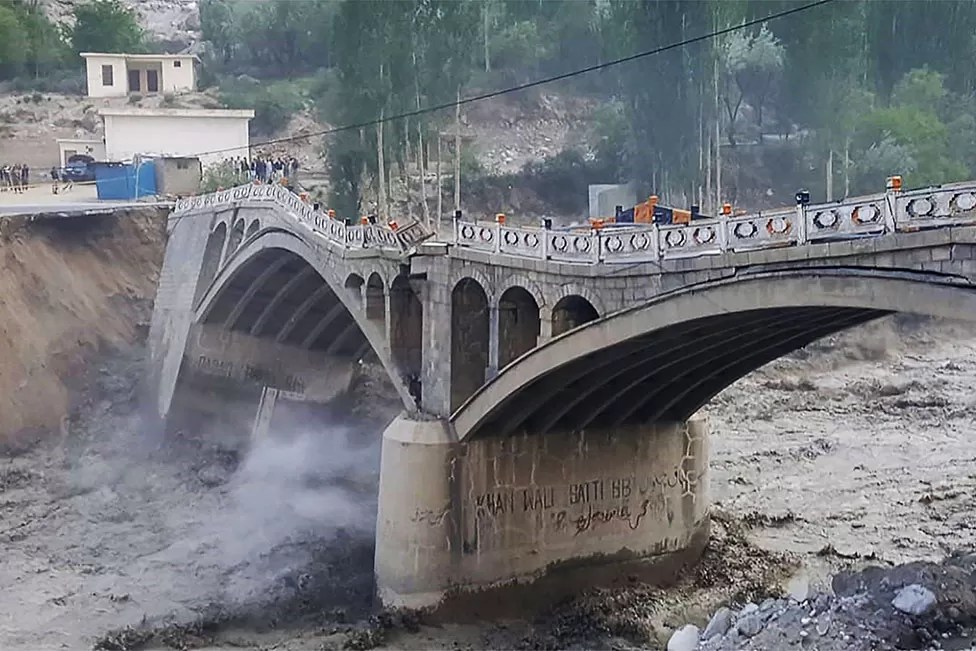
The devastating floods in Pakistan are a “wake-up call” to the world on the threats of climate change, experts have said.

The record-breaking rain would devastate any country, not just poorer nations, one climate scientist has told BBC News.

The human impacts are clear – another 2,000 people were rescued from floodwaters on Friday, while ministers warn of food shortages after almost half the country’s crops were washed away.

A sense of injustice is keenly felt in the country. Pakistan contributes less than 1% of the global greenhouse gases that warm our planet but its geography makes it extremely vulnerable to climate change.

“Literally, one-third of Pakistan is underwater right now, which has exceeded every boundary, every norm we’ve seen in the past,” Climate minister Sherry Rehman said this week.

Pakistan is located at a place on the globe which bears the brunt of two major weather systems. One can cause high temperatures and drought, like the heatwave in March, and the other brings monsoon rains.

The majority of Pakistan’s population live along the Indus river, which swells and can flood during monsoon rains.

The science linking climate change and more intense monsoons is quite simple. Global warming is making air and sea temperatures rise, leading to more evaporation. Warmer air can hold more moisture, making monsoon rainfall more intense.

Scientists predict that the average rainfall in the Indian summer monsoon season will increase due to climate change, explains Anja Katzenberger at the Potsdam Institute for Climate Impact Research.

But Pakistan has something else making it susceptible to climate change effects – its immense glaciers.

The northern region is sometimes referred to as the ‘third pole’ – it contains more glacial ice than anywhere in the world outside of the polar regions.

As the world warms, glacial ice is melting. Glaciers in Pakistan’s Gilgit-Baltistan and Khyber Pakhtunkhwa regions are melting rapidly, creating more than 3,000 lakes, the the UN Development Programme told BBC News. Around 33 of these are at risk of sudden bursting, which could unleash millions of cubic meters of water and debris, putting 7 million people at risk.

Pakistan’s government and the UN are attempting to reduce the risks of these sudden outburst floods by installing early-warning systems and protective infrastructure.

In the past poorer countries with weaker flood defences or lower-quality housing have been less able to cope with extreme rainfall.

But climate impact scientist Fahad Saeed told BBC News that even a rich nation would be overwhelmed by the catastrophic flooding this summer.

“This is a different type of animal – the scale of the floods is so high and the rain is so extreme, that even very robust defences would struggle,” Dr Saeed explains from Islamabad, Pakistan.

He points to the flooding in Germany and Belgium that killed dozens of people in 2021.

Pakistan received nearly 190% more rain than its 30-year average from June to August – reaching a total of 390.7mm.

He says that Pakistan’s meteorological service did a “reasonable” job in warning people in advance about flooding. And the country does have some flood defences but they could be improved, he says.

People with the smallest carbon footprints are suffering the most, Dr Saeed says.

“The victims are living in mud homes with hardly any resources – they have contributed virtually nothing to climate change,” he says.

The flooding has affected areas that don’t normally see this type of rain, including southern regions Singh and Balochistan that are normally arid or semi-arid.

Yusuf Baluch, a 17-year-old climate activist from Balochistan, says that inequality in the country is making the problem worse. He remembers his own family home being washed away by flooding when he was six years old.

“People living in cities and from more privileged backgrounds are least affected by the flooding,” he explains.

“People have the right to be angry. Companies are still extracting fossil fuels from Balochistan, but people there have just lost their homes and have no food or shelter,” he says. He believes the government is failing to support communities there.

Dr Saeed says the floods are “absolutely a wake-up call” to governments globally who promised to tackle climate change at successive UN climate conferences.

“All of this is happening when the world has warmed by 1.2C – any more warming than that is a death sentence for many people in Pakistan,” he adds.
Categories
environment

World’s wealthiest ‘at heart of climate problem’

The world’s wealthy must radically change their lifestyles to tackle climate change, a report says.

It says the world’s wealthiest 1% produce double the combined carbon emissions of the poorest 50%, according to the UN.

The wealthiest 5% alone – the so-called “polluter elite” – contributed 37% of emissions growth between 1990 and 2015.

The authors want to deter SUV drivers and frequent fliers – and persuade the wealthy to insulate their homes well.

The report urges the UK government to reverse its decision to scrap air passenger duty on UK return flights.

And it wants ministers to re-instate the Green Homes Grant scheme they also scrapped recently.

  • The document has come from the UK-based Cambridge Sustainability Commission on Scaling Behaviour Change.

It’s a panel of 31 individuals who study people’s behaviour relating to the environment. They were tasked to find the most effective way of scaling up action to tackle carbon emissions.

Their critics say the best way to cut emissions faster is through technological improvements – not through measures that would prove unpopular.

But the lead author of the report, Prof Peter Newell, from Sussex University, told BBC News: “We are totally in favour of technology improvements and more efficient products – but it’s clear that more drastic action is needed because emissions keep going up.

“We have got to cut over-consumption and the best place to start is over-consumption among the polluting elites who contribute by far more than their share of carbon emissions.

“These are people who fly most, drive the biggest cars most and live in the biggest homes which they can easily afford to heat, so they tend not to worry if they’re well insulated or not.

“They’re also the sort of people who could really afford good insulation and solar panels if they wanted to.”

Prof Newell said that to tackle climate change, everyone needs to feel part of a collective effort – so that means the rich consuming less to set an example to poorer people.

He continued: “Rich people who fly a lot may think they can offset their emissions by tree-planting schemes or projects to capture carbon from the air. But these schemes are highly contentious and they’re not proven over time.

The wealthy, he said, “simply must fly less and drive less. Even if they own an electric SUV that’s still a drain on the energy system and all the emissions created making the vehicle in the first place”.

Sam Hall, from the Conservative Environment Network, told BBC News: “It’s right to emphasise the importance of fairness in delivering (emissions cuts) – and policy could make it easier for people and businesses to go green – through incentives, targeted regulation and nudges.

“But encouraging clean technologies is likely to be more effective, and more likely to enjoy public consent, than hefty penalties or lifestyle restrictions.”

But Prof Newell said existing political structures allowed wealthy firms and individuals to lobby against necessary changes in society that might erode the lifestyles of the rich.

The recent report of the UK Climate Assembly, for example, proposed a series of measures targeting carbon-intensive behaviours such as shifting away from meat and dairy produce; banning the most polluting SUVs; and imposing frequent flyer levies.

The Treasury told BBC News that a frequent flyer levy might require the government to collect and store personal information on each passenger.

This could raise issues of data processing, handling and privacy issues. It would also be hard to keep track of people with multiple passports.

But the commission’s report said: “The goals of the Paris Agreement on climate change cannot be achieved without radical changes to lifestyles and shifts in behaviour, especially among the wealthiest members of society.

“If change across society is to be brought about at the speed and scale required to meet agreed climate targets, we need to shrink and share: reduce carbon budgets and share more equally.”

The report is the latest in a long-running dialogue over what it means to be “fair” while tackling climate change.

Poorer nations such as India have consistently argued that they should be allowed to increase their pollution because it’s so much lower per person than emissions from rich nations.

The issue forms part of the tangled tapestry of negotiations behind next week’s climate summit organised by President Biden and the COP climate summit in the UK scheduled for November.

Wealthy people :  Heart of climate problem
Design a site like this with WordPress.com
Get started