The devastating floods in Pakistan are a “wake-up call” to the world on the threats of climate change, experts have said.
The record-breaking rain would devastate any country, not just poorer nations, one climate scientist has told BBC News.
The human impacts are clear – another 2,000 people were rescued from floodwaters on Friday, while ministers warn of food shortages after almost half the country’s crops were washed away.
A sense of injustice is keenly felt in the country. Pakistan contributes less than 1% of the global greenhouse gases that warm our planet but its geography makes it extremely vulnerable to climate change.
“Literally, one-third of Pakistan is underwater right now, which has exceeded every boundary, every norm we’ve seen in the past,” Climate minister Sherry Rehman said this week.
Pakistan is located at a place on the globe which bears the brunt of two major weather systems. One can cause high temperatures and drought, like the heatwave in March, and the other brings monsoon rains.
The majority of Pakistan’s population live along the Indus river, which swells and can flood during monsoon rains.
The science linking climate change and more intense monsoons is quite simple. Global warming is making air and sea temperatures rise, leading to more evaporation. Warmer air can hold more moisture, making monsoon rainfall more intense.
Scientists predict that the average rainfall in the Indian summer monsoon season will increase due to climate change, explains Anja Katzenberger at the Potsdam Institute for Climate Impact Research.
But Pakistan has something else making it susceptible to climate change effects – its immense glaciers.
The northern region is sometimes referred to as the ‘third pole’ – it contains more glacial ice than anywhere in the world outside of the polar regions.
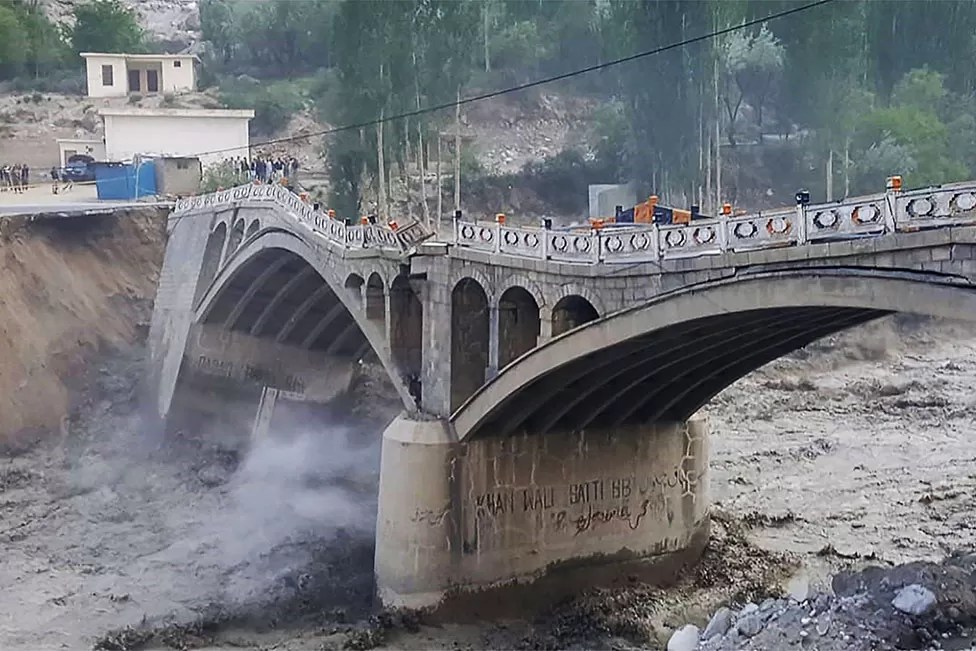
As the world warms, glacial ice is melting. Glaciers in Pakistan’s Gilgit-Baltistan and Khyber Pakhtunkhwa regions are melting rapidly, creating more than 3,000 lakes, the the UN Development Programme told BBC News. Around 33 of these are at risk of sudden bursting, which could unleash millions of cubic meters of water and debris, putting 7 million people at risk.
Pakistan’s government and the UN are attempting to reduce the risks of these sudden outburst floods by installing early-warning systems and protective infrastructure.
In the past poorer countries with weaker flood defences or lower-quality housing have been less able to cope with extreme rainfall.
But climate impact scientist Fahad Saeed told BBC News that even a rich nation would be overwhelmed by the catastrophic flooding this summer.
“This is a different type of animal – the scale of the floods is so high and the rain is so extreme, that even very robust defences would struggle,” Dr Saeed explains from Islamabad, Pakistan.
Pakistan received nearly 190% more rain than its 30-year average from June to August – reaching a total of 390.7mm.
He says that Pakistan’s meteorological service did a “reasonable” job in warning people in advance about flooding. And the country does have some flood defences but they could be improved, he says.
People with the smallest carbon footprints are suffering the most, Dr Saeed says.
“The victims are living in mud homes with hardly any resources – they have contributed virtually nothing to climate change,” he says.
The flooding has affected areas that don’t normally see this type of rain, including southern regions Singh and Balochistan that are normally arid or semi-arid.
Yusuf Baluch, a 17-year-old climate activist from Balochistan, says that inequality in the country is making the problem worse. He remembers his own family home being washed away by flooding when he was six years old.
“People living in cities and from more privileged backgrounds are least affected by the flooding,” he explains.
“People have the right to be angry. Companies are still extracting fossil fuels from Balochistan, but people there have just lost their homes and have no food or shelter,” he says. He believes the government is failing to support communities there.
Dr Saeed says the floods are “absolutely a wake-up call” to governments globally who promised to tackle climate change at successive UN climate conferences.
“All of this is happening when the world has warmed by 1.2C – any more warming than that is a death sentence for many people in Pakistan,” he adds.
There are a surprising amount of people, businesses, and communities that would like to do more to conserve and protect our natural resources, but they don’t know where to begin with becoming more environmentally friendly.
Understanding what makes each of these aspects of our world part of the process of changing and conserving our resources, and learning how to get started creating a difference is the first thing you have to learn.
Being environmentally friendly simply means having a lifestyle that is better for the environment.
It’s just taking small steps towards looking after the mother earth to make this planet a better place for our communities and generations to come.
A good way would be to start with conserving water, driving less and walking more, consuming less energy, buying recycled products, eating locally grown vegetables, joining environmental groups to combat air pollution, creating less waste, planting more trees, and many more.
“Environment friendly processes, or environmental-friendly processes (also referred to as eco-friendly, nature-friendly, and green), are sustainability and marketing terms referring to goods and services, laws, guidelines and policies that claim reduced, minimal, or no harm upon ecosystems or the environment.”
Why it’s Important to Become Environmentally Friendly?
You can’t just point towards one business or practice and blame them for all of our environmental woes; everything fits together like a puzzle.
The more we all do our part – the faster we will create an entire ecology of living that promotes sustainability. The first step is to begin to understand the basics of what each part of life can do to become more environmentally friendly.
The next step is to start to learn to make different choices on a personal level that help in changing your awareness and consumption of resources. The changes are surprisingly easy to make; there are more ways than you can imagine to begin to practice conservation.
The Three Distinctive Environmentally Friendly Categories
Everything from the way that products are displayed and advertised, how waste is recycled, whether or not changes can be made to the basic operations of a business will all work towards making them more environmentally responsible.
A large emphasis on non-producing businesses can be placed on the management of supplies.
Buying local may not always be the most responsible way to get supplies, but it can be as well. How a business works to support their community in their environmental conservation efforts is also another important task of the environmentally friendly business.
2. The Environmentally Friendly Community
In an environmentally friendly community, there is more than just a good recycling program in place.
Communities that are committed to conservation and preservation of resources work to encourage options like community playgrounds, public transportation, green construction, and also to change the way that fossil fuels and other resources are used to support community services.
3. The Environmentally Friendly Person
The environmentally friendly person is the person who moves through life with an awareness of how natural resources are used to create and support the life that they live.
They recycle, conserve water and fuel, and make other choices that not only lessen their impact on the environment but also support industries that are working towards being more environmentally responsible.
Easy Ways to Become More Environmentally Friendly
1. Become More Aware of Resources
Start by living with a greater awareness of the resources that you use in your daily life. Pay attention to how you choose to heat, to travel, to use water, and use products that were made by manufacturing practices.
With your new awareness of how natural resources are used in your life, start to practice conservation. It can be as simple as turning off the lights as you leave a room and as complex as making different choices when it comes to building your home. Learn here more about 15 green home building techniques.
3. Plant Trees
Trees are necessary for us to survive. They give oxygen, fruits, clean the air, provide shelter to wildlife, prevent soil erosion. A shady landscape around your home can help you to reduce the consumption of energy and keep your home cool even during summers.
Plant small trees around your home and don’t cut trees unless it’s necessary; work with local environmental groups to plant more trees and educate others about the positive aspects of it.
4. Conserve Water
Water needs to be conserved as a lot of energy is required to pump water from rivers or lakes into your home. Conserving water reduces the amount of energy that is needed to filter it.
Few ways to conserve water are – take short showers, fix leaking pipes, keep the running tap close while you brush your teeth, recycle water in your home, use water-saving appliances, collect rainwater in a rain barrel to water your lawn.
5. Try Renewable Energy, Go Rooftop Solar
Rooftop Solar Photovoltaic (PV) is accelerating access to affordable and clean electricity. Roof modules are spreading worldwide because of their affordability. Solar PV has benefited from a virtuous cycle of falling costs that is cheap, and you can easily install it to go environmentally friendly.
6. Change to LED Light Bulbs
Count the bulbs you have in your home. Change them to LED light bulbs that last longer than conventional bulbs and far more efficient. Not only that! They’re available in a varied range of brightness and designs that you can tailor the lighting to suit your room. This way, you’ll be using less power
7. Cut Down Meat on your Plate
If you want to be environment-friendly, simply cut down the amount of meat you consume, and that would have a massive impact on the environment. If you can avoid it just for 2-3 days a week, that would even have quite a significant effect on reducing your carbon footprint.
As billions of people dine multiple times a day, if they apply this, imagine how many opportunities exist to turn the tables. Of course, it is possible to eat well with vegetables, fruits, grains, and legumes, in terms of both nutrition and pleasure and thereby help lower emissions.
8. Stop Food Waste
You waste food sometimes intentionally and sometimes unintentionally. Regardless of the reason, producing uneaten food is a waste of a whole host of resources such as seeds, water, energy, land, fertilizer, hours of labor, and capital invested.
It also generates greenhouse gases at every stage, including methane, when you throw them and the organic matter lands in the global dustbin.
You can make a huge difference by cooking, serving, or ordering the amount that can actually be consumed and ensuring there is no waste.
9. Change Your Travel Habits
Driving and flying are two areas where you can make a real impact through environmentally friendly practices. Choose fuel-efficient travel options, travel less, and try to pick more direct routes to save on fuel. If your office is near your home, try to ride a bicycle instead of a car.
10. Use Less Fossil Fuel Based Products
Find out what products and consumables you use that are made using fossil fuel-based products and processes and use them less or replace them in your life.
11. Buy Locally Grown Products
An easy way to reduce your carbon footprint is to buy locally grown products. When you shop locally instead of buying products that were shipped from far away, you are actually supporting local dairies and farms.
Apart from this, you can follow organic farming practices and can grow food, including herbs and veggies, in your own backyard, Windowsill boxes, and roof and can sell the surplus to your friends.
12. Reduce the Use of Harmful Chemicals
The chemicals like paint, oil, ammonia, and other chemical solutions are hazardous and, when disposed of openly, can cause pollution in the air and the water.
These chemicals can seep into the groundwater. The polluted air and water can cause severe consequences to human health. Therefore, they should be disposed of to a toxic waste site for safe disposal.
13. Use Green Cleaning Products
You use a lot of cleaning products every day that contain many harmful chemicals that aren’t environmentally friendly to create or at their disposal.
The repeated exposure to these cleaning products affects your health as well as the environment. Use green cleaning products using more natural and organic methods.
14. Composting
Composting is a natural process that takes remains of plants and kitchen waste and converts it into rich nutrient food for your plants that helps them grow. It reduces the amount of garbage that goes to landfills, which pollutes the air. This way, it proves safe for the environment.
Reduce simply means reducing what is produced and what is consumed. Reuse items for a different purpose instead of sending them to landfills. To recycle something means that it will be transformed again into a raw material that can be shaped into a new item.
16. Choose Personal Hygiene Items Carefully
Be it your toothpaste, body wash, face scrub, and any other products, make sure that those do not contain microbeads which are small bits of solid plastic that make their way into watercourses and ultimately end up damaging the environment by entering the food chain.
Besides, also avoid chemicals and opt for natural cleaning products to keep yourself and the environment clean.
17. Buy Recycled Products
When you go out shopping, try to buy products from the market that are made up of recycled materials with minimal packaging, i.e., the product should be environment-friendly. Look into manufacturing processes to check if it was made from recycled materials or the use of plastics or chemicals was involved in its production.
You can improve your recycling or repairing skills as the internet gives access to the tools and information you need to fix practically anything and recycle mostly everything, from batteries to paper to cars. Before throwing anything, try to turn it into something else you can use
18. Try Without Plastic
You may find it challenging to go without using plastic as it appears to exist in every single aspect of our lives. However, it isn’t as tricky as you are thinking.
Taking a canvas bag along with you when you go shopping, buying fruits and vegetables loose, and not buying bottled water can even make much difference. If you try, you can find alternatives.
19. Join Environment Groups
You may find different environmental groups in your city with whom you can join hands to protect mother earth and make the environment clean. A quick Google search can help you in finding such groups. You can also pull your friends and relatives and ask them for a helping hand.
20. Stop Littering
One of the familiar sights that we see daily on the streets is seeing people littering on roads.
great way to keep the environment and the surrounding clean around you is to stop people from littering on roads. Instead, educate them to put trash and garbage in dustbins. The pile of garbage on the street hampers the beauty of the city and also pollutes the air.
21. Protect Wildlife
Human activity is leading to the extinction of endangered species and habitats. Protect places like beaches and forests that are habitats for animals. Join hands with the local forest department to protect animal habitats.
22. Educate Others
Educate others about the importance of living an environmentally friendly life. The more people share an awareness of the importance of the environment, the more we can do together to conserve it.
LONDON (AP) — Britain shattered its record for highest temperature ever registered Tuesday amid a heat wave that has seared swaths of Europe, as the U.K.’s national weather forecaster said such highs are now a fact of life in a country ill-prepared for such extremes.
The typically temperate nation was just the latest to be walloped by unusually hot, dry weather that has triggered wildfires from Portugal to the Balkans and led to hundreds of heat-related deaths. Images of flames racing toward a French beach and Britons sweltering — even at the seaside — have driven home concerns about climate change.
The U.K. Met Office weather agency registered a provisional reading of 40.3 degrees Celsius (104.5 degrees Fahrenheit) at Coningsby in eastern England — breaking the record set just hours earlier. Before Tuesday, the highest temperature recorded in Britain was 38.7 C (101.7 F), set in 2019. By later afternoon, 29 places in the UK had broken the record.
As the nation watched with a combination of horror and fascination, Met Office chief scientist Stephen Belcher said such temperatures in Britain were “virtually impossible” without human-driven climate change.
He warned that “we could see temperatures like this every three years” without serious action on carbon emissions.
The sweltering weather has disrupted travel, health care and schools. Many homes, small businesses and even public buildings, including hospitals, in Britain don’t have air conditioning, a reflection of how unusual such heat is in the country better known for rain and mild temperatures.
The intense heat since Monday has damaged the runway at London’s Luton airport, forcing it to shut for several hours, and warped a main road in eastern England, leaving it looking like a “skatepark,” police said. Major train stations were shut or near-empty Tuesday, as trains were canceled or ran at low speeds out of concern rails could buckle.
London faced what Mayor Sadiq Khan called a “huge surge” in fires because of the heat. The London Fire Brigade listed 10 major blazes it was fighting across the city Tuesday, half of them grass fires. Images showed several houses engulfed in flames as smoke billowed from burning fields in Wennington, a village on the eastern outskirts of London.
Sales of fans at one retailer, Asda, increased by 1,300%. Electric fans cooled the traditional mounted troops of the Household Cavalry as they stood guard in central London in heavy ceremonial uniforms. The length of the changing of the guard ceremony at Buckingham Palace was shortened. The capital’s Hyde Park, normally busy with walkers, was eerily quiet — except for the long lines to take a dip in the Serpentine lake.
“I’m going to my office because it is nice and cool,” said geologist Tom Elliott, 31, after taking a swim. “I’m cycling around instead of taking the Tube.’’
Ever the stalwart, Queen Elizabeth II carried on working. The 96-year-old monarch held a virtual audience with new U.S. ambassador Jane Hartley from the safety of Windsor Castle.
A huge chunk of England, from London in the south to Manchester and Leeds in the north, remained under the country’s first “red” warning for extreme heat Tuesday, meaning there is danger of death even for healthy people.
Such dangers could be seen in Britain and across Europe. At least six people were reported to have drowned while trying to cool off in rivers, lakes and reservoirs across the U.K. In Spain and neighboring Portugal, hundreds of heat-related deaths have been reported in the heat wave.
Climate experts warn that global warming has increased the frequency of extreme weather events, with studies showing that the likelihood of temperatures in the U.K. reaching 40 C (104 F) is now 10 times higher
than in the pre-industrial era.
The head of the U.N. weather agency expressed hope that the heat gripping Europe would serve as a “wake-up call” for governments to do more on climate change. Other scientists used the milestone moment to underscore that it was time to act.
“While still rare, 40C is now a reality of British summers,” said Friederike Otto, Senior Lecturer in Climate Science at Imperial College London’s Grantham Institute for Climate Change. “Whether it will become a very common occurrence or remains relatively infrequent is in our hands and is determined by when and at what global mean temperature we reach net zero.”
Extreme heat broiled other parts of Europe, too. In Paris, the thermometer in the French capital’s oldest weather station – opened in 1873 – topped 40 C (104 F) for just the third time. The 40.5 C (104.9 F) measured there by weather service Meteo-France on Tuesday was the station’s second-highest reading ever, topped only by a blistering 42.6 C (108.7 F) in July 2019.
Drought and heat waves tied to climate change have also made wildfires more common and harder to fight.
In the Gironde region of southwestern France, ferocious wildfires continued to spread through tinder-dry pines forests, frustrating firefighting efforts by more than 2,000 firefighters and water-bombing planes.
Tens of thousands of people have been evacuated from homes and summer vacation spots since the fires broke out July 12, Gironde authorities said.
A smaller third fire broke out late Monday in the Medoc wine region north of Bordeaux, further taxing resources. Five camping sites went up in flames in the Atlantic coast beach zone where blazes raged around the Arcachon maritime basin famous for its oysters and resorts.
In Greece, a large forest fire broke out northeast of Athens, fanned by high winds. Fire Service officials said nine firefighting aircraft and four helicopters were deployed to try to stop the flames from reaching inhabited areas on the slopes of Mount Penteli, some 25 kilometers (16 miles) northeast of the capital. Smoke from the fire blanketed part of the city’s skyline.
But weather forecasts offered some consolation, with temperatures expected to ease along the Atlantic seaboard Tuesday and the possibility of rains rolling in late in the day.
Cloudburst happens when an extreme amount of precipitation occurs in a short period of time within a smaller geographical area. This article precisely describes what is cloudburst, how such clouds are formed and what causes them to burst. Also, know about flash floods here.
Rains are the blessings to all the living beings on the Earth because it is responsible for depositing most of the fresh water on the Earth and also provides suitable conditions for many types of ecosystems, as well as water for hydroelectric power plants and crop irrigation. The term “rainfall” is used to describe precipitation in the form of water drops of sizes larger than 0.5 mm.
Other forms are snow, drizzle, glaze, sleet, hail and cloudburst. But Global warming causes global changes in the precipitation pattern that’s why we keep hearing about clouds bursting every now and then, especially in the hills of North India.
Here, we are giving a detailed explanation of cloudbursts, how such clouds form and what causes the clouds to burst and release all the water at once for general awareness.
What is Cloudburst?
It is an extreme amount of precipitation in a short period of time to a small geographical area. Meteorologists say the rain from a cloudburst is usually of the shower type with a fall rate equal to or greater than 100 mm (4.94 inches) per hour.
Cloudburst is basically a rainstorm and occurs mostly in the desert and mountainous regions, and in interior regions of continental landmasses due to the warm air current from the ground or below the clouds rushes up and carries the falling raindrops up with it. The rain fails to fall down in a steady shower, which causes excessive condensation in the clouds as new drops form and old drops are pushed back into it by the updraft.
How is cloudburst different from rainfall?
Rain is condensed water falling from a cloud while cloudburst is a sudden heavy rainstorm. A report in the Down to Earth said a cloudburst is different from rain only in the amount of rainfall recorded. Rain over 100mm per hour is categorised as a cloudburst.
Hence, we can say the cloudburst is a natural phenomenon, but occur quite unexpectedly, very abruptly, and rather drenching. In the Indian Subcontinent, it generally occurs when a monsoon cloud drifts northwards, from the Bay of Bengal or the Arabian Sea across the plains than on to the Himalaya that sometimes brings 75 millimetres of rain per hour.
How is cloudburst different from rainfall?
Rain is condensed water falling from a cloud while cloudburst is a sudden heavy rainstorm. A report in the Down to Earth said a cloudburst is different from rain only in the amount of rainfall recorded. Rain over 100mm per hour is categorised as a cloudburst.
Hence, we can say the cloudburst is a natural phenomenon, but occur quite unexpectedly, very abruptly, and rather drenching. In the Indian Subcontinent, it generally occurs when a monsoon cloud drifts northwards, from the Bay of Bengal or the Arabian Sea across the plains than on to the Himalaya that sometimes brings 75 millimetres of rain per hour.
How is cloudburst different from rainfall?
Rain is condensed water falling from a cloud while cloudburst is a sudden heavy rainstorm. A report in the Down to Earth said a cloudburst is different from rain only in the amount of rainfall recorded. Rain over 100mm per hour is categorised as a cloudburst.
Hence, we can say the cloudburst is a natural phenomenon, but occur quite unexpectedly, very abruptly, and rather drenching. In the Indian Subcontinent, it generally occurs when a monsoon cloud drifts northwards, from the Bay of Bengal or the Arabian Sea across the plains than on to the Himalaya that sometimes brings 75 millimetres of rain per hour.
Cloudburst: Why in news?
Around five bodies have been recovered and more than 40 people have been reported missing after a cloudburst hit a remote village in Jammu and Kashmir’s Kishtwar district on 28 July 2021. Around nine houses have been damaged due to the cloudburst.
Earlier, a cloudburst occurred in Dharamshala leading to massive flash floods. Manjhi river has been flooded after a reported rainfall of 3000 mm.
As climate scientists predicted, glaciers are vanishing due to rapidly warming temperatures.
With global warming, we can make predictions and then take measurements to test those predictions. One prediction (a pretty obvious one) is that a warmer world will have less snow and ice. In particular, areas that have year-round ice and snow will start to melt.
Alpine glaciers are large bodies of ice that can be formed high in mountains, typically in bowls called cirques. The ice slowly flows downwards, pulled by gravity, and is renewed in their upper regions. A sort of balance can occur where the loss of ice by melting or flowing at the bottom is equal to the gain of snow and ice by precipitation.
As the Earth warms, the melt line moves upwards so that the glacier melts faster and faster at the bottom, shortening the glacier and reducing its mass. Ultimately, the melted water flows into streams and rivers and ends up in the oceans, contributing to accelerating sea level rise.
While glaciers are interesting from an intellectual standpoint, they are also important to ecosystems and society. For example, the rate of glacier melt affects downstream water levels, river flowrates, and the water available for human use. So, it would be really important for us to be able to predict what will happen with glaciers in the future and plan for how water availability will change.
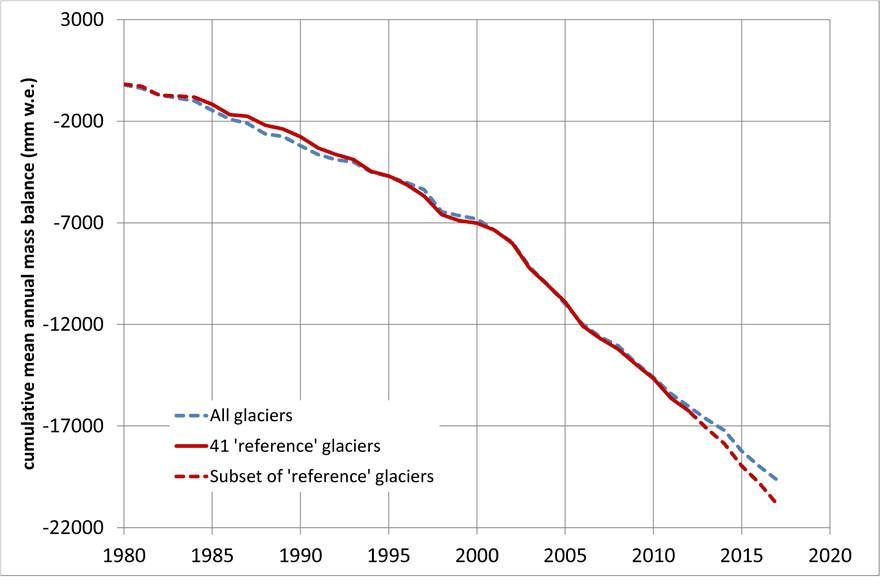
Of the groups that track glaciers, my favorite is the World Glacier Monitoring Service, which publishes a survey of the mass changes from selected glaciers around the world, available here and summarized below. The graph shows changes to the mass of the glaciers that are monitored, measured in millimeters of equivalent water.
Changes to water content of glaciers. Illustration: World Glacier Monitoring Service
But this doesn’t tell the whole story because there is very little information about glacier health in the high latitudes (Northern Alaska, Canada, Northern Europe, Northern Russia, etc.). Very few temperature records exist in high elevations in these regions. Furthermore, the temperatures do not extend back very far in time. So, it is challenging for scientists to develop a long-term perspective on glacier health in these areas.
And this is why a new study attracted my attention. A paper was just published by the American Geophysical Union that shared research carried out by Dominic Winski and his colleagues.
This team of researchers extracted ice cores from the glaciers on Mt. Hunter, in Alaska. The ice cores held snow and ice from as far back as 400 years. The researchers showed that the amount of water melt currently is 60 times greater than it was prior to 1850. They also found that the summertime temperature changes on Mt. Hunter are almost 2°C per century (about 3.5°F). To put this in perspective, the temperatures are rising about twice as fast as global temperatures.
The fact that temperatures on these northern mountains is rising faster than the globe as a whole is something predicted by climate models. The reason it warms so fast in these locations is that as the warming starts, snow begins to melt, exposing dark soil, which absorbs more sunlight, leading to more warming. We call this a feedback loop. There are other feedbacks at play, including changes to vertical temperatures in the air, changes to clouds, and changes to atmosphere currents. These areas were predicted to warm particularly fast, and the measurements confirm the predictions.
The authors recognized that during the summer, the top layer of snow and ice can melt. The liquid water permeates the ice beneath it and refreezes, creating a more solid ice layer than before. Because the bands of solid ice are formed from melting snow, more bands of solid ice mean that summer temperatures were above freezing when the ice bands formed. Measuring the number and thickness of these bands through time gives information about how warm the summer temperatures are.
So basically, the authors used these annual ice-core bands to deduce temperatures as far back as 400 years ago. They found that the frequency of melting events increased by 57-fold from the 1650–1850 time period compared with 1980–2011. They also measured a 60-fold increase in total melt. These are staggering numbers. I asked the lead author, Dominic Winski to summarize his findings and he told me,
This research shows that peaks in the Alaska Range sustain additional summertime warming through links with rising ocean temperatures in the tropics. Not only have we learned that summers are much warmer on Mt. Hunter than they were hundreds of years ago, but our research also demonstrates how connected the climate system is, with changes in certain parts of the world affecting places thousands of miles away.
It will be interesting to see if others can replicate these findings in other locations. But the collaboration of the conclusions with other evidence is quite compelling. Good work, researchers.
Miles Glacier and Miles Lake Chugach National Forest near Cordova, Alaska.
It had been an unusually warm early June in Yellowstone National Park, with temperatures in the 70s. Then a weekend storm intensified quickly, dropping a month’s worth of precipitation on the park in little more than a day. The rivers and creeks were already running high, filled with melting snow from an above-average snowpack. By Monday, the Gardner River—whose headwaters are on the west side of the park, in the Gallatin Mountains—was a muddy, rushing torrent.
As it churned down the Gardner Canyon below Mammoth Hot Springs, the river took chunks of the adjacent roadway along with it. Choked with debris, the floodwaters joined the Yellowstone River at the foot of the canyon; the surge pushed on more than 50 miles north, inundating Yankee Jim Canyon, Paradise Valley and the town of Livingston.
Conditions were similar across the park, as creeks and waterways rose to record-breaking levels, covering roadways and sweeping away bridges. On Monday, Yellowstone’s superintendent, Cam Sholly, announced the closure of all five of Yellowstone’s inbound entrances and the evacuation of most tourists from the area.
The extreme weather took a heavy toll on the town of Gardiner, Montana, which sits at the confluence of the Gardner (more on the spelling discrepancy later) and Yellowstone rivers. Floodwaters cut off Gardiner’s almost 900 residents from both Livingston and the park’s headquarters at Mammoth Hot Springs, leaving them without power and drinkable water for several days.
“The road that I took from Yellowstone Park to [Gardiner], I drove on it probably 10:30 p.m. Sunday night,” Dawson Killen, a tourist from Texas who found herself stranded in Gardiner, told ABC FOX Montana. “By the time I woke up [Monday], the road didn’t exist anymore.”
This early summer flood was the latest in a series of dynamic events that have shaped Gardiner over the past two centuries. It shows how the very conditions that create thriving, successful gateway towns—defined as communities located just outside of national parks and historic sites—make them vulnerable to destruction.
What is now the town of Gardiner sits between the Gallatin and Absaroka mountain ranges. For thousands of years, the two rivers that rush down from the Yellowstone caldera and into this valley drew bison, elk and wolves—and the Apsaalooké (Crow), northern Cheyenne, Arapaho, Shoshone-Bannock and other Indigenous hunters who followed.
The first white man to take up residence at the confluence was Johnson Gardner, an American Fur Company trapper who caught beavers along the Yellowstone River in the 1830s. The area became known as Gardner’s Hole, in part due to legendary guide Jim Bridger, who used the name when he brought the Washburn-Langford-Doane expedition to Yellowstone in 1870. The name of the campsite (but not the river) was misspelled in the expedition’s accounts, and in the official government report of geologist Ferdinand Hayden, who brought the first federally funded scientific team into Yellowstone the following year.
Hayden’s survey led to the passage of the Yellowstone National Park Protection Act in 1872, preserving more than one million acres in the Yellowstone Basin and creating the first national park in the world. Within the year, entrepreneurs had built a toll road from Bozeman, Montana, to Gardiner and up to Mammoth Hot Springs. Settlers arrived and built a restaurant and bakery, post office, schoolhouse, barber shop, saloon, general store, and hotel. But the area was still difficult to reach; only a few hundred tourists came through Gardiner to visit Yellowstone in the next ten years.
In 1882, the Northern Pacific Railroad reached the town of Livingston, and the hundreds of tourists became thousands, disembarking at Livingston and then taking stagecoaches to Gardiner and the park. It wasn’t until the completion of a Northern Pacific spur line—a short extension of the track from the main line at Livingston to the park’s northern entrance—in 1902, however, that Gardiner’s status as the park’s first gateway town was secured.
As the first issue of the Gardiner Wonderland declared in May 1902, “This town is the supply point of the surrounding country, and headquarters for most of the team work and freighting in and about the park.”
By then, officials had established the park’s headquarters at Mammoth Hot Springs, one of Yellowstone’s premier attractions. But visitors also wanted to see the upper and lower falls of the Grand Canyon of the Yellowstone, as well as Old Faithful and the other wonders of the geyser region.
Park personnel constructed two “loop roads” connecting these sites and several new entrances, which linked the park to communities that would become additional gateway towns: Jackson Hole (south) and Cody (east) in Wyoming and West Yellowstone (west) and Cooke City (northeast) in Montana. The western entrance quickly became the park’s most popular. After 1902, when the southern entrance was completed, Jackson Hole and Gardiner vied for the second spot.
To promote Gardiner’s role as the first gateway—and to provide tourists entering the park there with a dramatic experience—town leaders and United States Army officials (who oversaw Yellowstone at the time) built a 50-foot-tall basalt arch in 1903. President Theodore Roosevelt, who was visiting Yellowstone that spring, laid the cornerstone and gave a short speech.
“The Yellowstone Park is something absolutely unique in the world so far as I know,” Roosevelt told a cheering crowd. “Nowhere else in any civilized country is there to be found such a tract of veritable wonderland made accessible to all visitors.”
In the almost 120 years since the arch’s dedication, Gardiner has played an important role in making the park accessible, pivoting to meet escalating numbers of visitors and adapt to transportation revolutions. In 1915, officials authorized automobiles’ entry into the park. Gas stations, garages and auto repair shops quickly replaced stables, barns and liveries. The town widened its streets, and the commercial corridor expanded.
In 1948, as train ticket sales declined due to the American embrace of the automobile, the Northern Pacific Railroad decided to end passenger rail service to Gardiner. That same year, visitation to Yellowstone reached one million for the first time; an estimated 18 to 20 percent of these travelers came through Gardiner.
Gardiner is in many ways typical of Yellowstone’s gateway communities—and other such towns across the nation—in its long history of tourism and economic growth stemming from close relationships with iconic American landscapes. It is unique, however, in being the site of much of Yellowstone National Park’s “official” infrastructure. Due to Gardiner’s proximity to park headquarters at Mammoth Hot Springs, the park built a Heritage and Research Center that houses manuscript, book and object collections related to Yellowstone’s history there in 2005. Yellowstone Forever, the official nonprofit partner of the park that supports education and fundraising projects, is also based in Gardiner.
These places draw visitors, as does the town itself. Gardiner’s location at the end of the bucolic Paradise Valley, and its quaint main street perched high above the Yellowstone River, makes it, as the town’s chamber of commerce likes to say, “nature’s favorite entrance.” It’s also the only gateway community to offer year-round entrance to Yellowstone, giving business leaders an advantage in attracting shoulder season visitors.
These are all benefits for Gardiner and its residents. But gateway communities balance on the sharpest segment of a double-edged sword. They rely almost entirely on tourism for their existence, yet too much tourism can destroy them.
In 2013, for example, local, state and federal agencies poured money into infrastructure improvements in Gardiner to prepare for the National Park Service’s 2016 centennial celebrations. While residents of the town appreciated the new sidewalks, lighting and tax revenue that resulted from the program, somecame to resent the accompanying uptick in tourist traffic, according to a 2018 survey by the University of Montana. The town was flourishing, but it was also more crowded and less peaceful.
The Covid-19 pandemic exacerbated these problems. In spring 2020, quarantine orders cut off the flow of tourists to Yellowstone and threw Gardiner and the park’s other gateway communities into economic disarray. Then, the surge of tourists heading back into the region in summer 2020 and 2021 put stress on hotels and restaurants experiencing massive labor shortages, as well as hospitals dealing with out-of-towners who contracted Covid while on the road. The pandemic also brought a large new population of transplants to the region, most of them white-collar workers who could log into their jobs from anywhere with a decent Wi-Fi signal.
As a result of this tourism boom, housing prices skyrocketed, and an increasing number of apartments and houses in Gardiner were turned into Airbnbs and other short-term rentals, making it difficult for people who want to work at the park and its related businesses to find a place to live. The situation has created friction between locals and visitors.
These demographic shifts, like every aspect of Gardiner’s history, are both beneficial and damaging to its prospects. Gardiner’s status as a gateway community is the reason for its success but also makes the town vulnerable to larger changes in government policy, technological innovation and global events. This weekend’s flood also points to the fact that Gardiner is vulnerable to climate change.
Last summer, a study of the Greater Yellowstone Ecosystem found that while average precipitation across the region has not changed significantly since 1950, temperatures have risen steadily, resulting in more rain (rather than snow) at higher elevations in late spring. Though the recent flooding was unprecedented, the conditions that created it will likely become increasingly common: accelerated snowmelt, combining with spring storms bringing too much rain for Yellowstone’s creeks and rivers to handle. Even if Montana and Wyoming residents take steps to mitigate climate change in the next few years, the report’s authors point out, temperatures will continue to rise, and more extreme weather events will take place.
The havoc that the Gardner River wreaked on the canyon road to Mammoth doesn’t bode well for the town. The road into the park will probably be closed until next year at the earliest. Without access to Yellowstone, tourists are unlikely to travel all the way down to Gardiner just to hike or go whitewater rafting. The local economy will be devastated in the short term. The park itself will also undergo changes; without the Gardiner entrance to bring visitors into the northern part of Yellowstone, rangers and other staff will face overcrowding and traffic jams throughout the rest of the park.
The challenges to recovery will be immense. Gardiner’s residents—and the National Park Service—cannot ignore the impact of recent demographic shifts or the strong likelihood of a more volatile climate in the future. What Gardiner’s long history shows, however, is that this weekend’s floods are one turbulent moment in a series of such moments. To remain “nature’s favorite entrance” to Yellowstone, this gateway town will have to adjust, yet again, to momentous changes occurring on the edges of America’s first national park.
World No Tobacco Day is observed on May 31 every year since 1987. This year, the World Health Organization’s (WHO) theme for the Day is “Tobacco: Threat to our environment.” This drive aims to create awareness among the public on the detrimental impact of tobacco cultivation, production, distribution, and waste on the environment, besides human health.
According to WHO, about 3.5 million hectares of land are cleared for growing tobacco each year. It causes deforestation mainly in the developing nations. Tobacco cultivation results in soil degradation, making it infertile to support the growth of other crops or vegetation. Tobacco contributes 84 megatons of the greenhouse gas carbon dioxide to the atmosphere every year; around twenty-two billion litres of water is consumed in the production of cigarettes every year.
The situation is no different in India, where tobacco is one of the important cash crops. Today, India is the second-largest crop producer in the world after China. According to the Central Tobacco Research Centre of the Indian Council of Agricultural Research (ICAR), around 760 million kg of Tobacco is grown in India on about 40 lakh hectares of land. The sector provides jobs to millions of people and contributes as much as Rs.22,737 crore as excise duty and Rs.5,969 crore in foreign exchange to the national treasury.
But a massive cost of tobacco cultivation is paid for by the country’s environment and people’s health. A report by the Ministry of health and family welfare says that “The total economic costs attributable to tobacco use from all diseases in India in the year 2011 for persons aged 35-69 amounted to Rs. 1,04,500 crores”.
It is estimated that about 29% of the adult Indian population consumes Tobacco. Most commonly, it is consumed as Smokeless Tobacco Products like khaini, gutkha, and zarda. Smoking forms of tobacco are used as bidi, cigarette, hookah, etc. The smokeless forms pose high risks of oral and oesophageal cancer. Their consumption by pregnant women can also lead to stillbirth and low birth weight in infants. People addicted to smoking are, on the other hand, at very high risk of lung, oral cavity, pharynx, nasal cavity, larynx, esophagus, stomach, pancreas, liver, kidney, ureter, urinary bladder, uterine cervix, and bone marrow cancers.
Tobacco kills more people than tuberculosis, HIV/AIDS, and malaria combined worldwide. It has also been reported that tobacco consumption in both smoking and chewing forms is significantly associated with severe COVID-19 symptoms. Tobacco users’ pre-existing health conditions, such as respiratory and cardiovascular disease, were observed to exacerbate disease symptoms, making treatment of COVID-19 patients more difficult owing to their fast clinical deterioration.
The environmental impacts of tobacco cultivation also add to India’s enormous economic burden. Tobacco is a very nutrient-hungry crop, and it depletes soil nutrients more rapidly. Tobacco cultivation requires the application of pesticides and fertilizers in large amounts, which degrade overall soil health. Tobacco cultivation results in soil erosion because it is typically grown as a monocrop (the practice of cultivating a single crop on the same farmland year after year), exposing the topsoil to wind and water.
Besides, health risks are associated even with tobacco cultivation apart from consumption. Tobacco farmers are prone to suffer from a work-related ailment known as “Green Tobacco Sickness” (GTS), which is caused mainly by nicotine absorption via the skin. Nicotine is an addictive chemical found in tobacco. The studies carried out by the National Institute of Occupational Health (NIOH) on CTRI farms in Andhra Pradesh reveal discoloration of workers’ skin coming into contact with tobacco leaves. Headache, nausea/vomiting, dizziness, lack of appetite, exhaustion, and weakness are all signs of GTS, which can be caused even by tobacco storage in houses. Severe nicotine poisoning can adversely affect reproductive health and lead to breathlessness, blood pressure fluctuations, heart attack, and cancer.
To cope with the tobacco epidemic, the Government of India enacted an extensive tobacco control law: The Cigarettes and Other Tobacco Products Act 2003 (COTPA 2003), in 2004. This Act includes the prohibition of smoking in public places, advertisement of cigarettes and other tobacco products, sale of cigarettes or other tobacco products to anyone below the age of 18 years, and prohibition of selling areas like schools, colleges, etc.
To make India addiction-free, the Government has launched programmes like National Tobacco Control Programme and Nasha Mukt Bharat Abhiyaan. Department of Agriculture, Cooperation & Farmers Welfare is also implementing a crop diversification programme. Farmers are encouraged to replace tobacco crops with less water-consuming alternatives to conserve water and soil. Under irrigated conditions, sugarcane, onion, maize, etc., and under rain-fed conditions, groundnut and soybean could be potential alternatives to tobacco farming.
The WHO’s this year’s campaign on “Tobacco: Threat to our Environment” urges governments and policymakers to strengthen legislation and implementation of existing schemes that hold tobacco companies accountable for the environmental and economic costs of waste tobacco products.
The insects that keep the world running by pollinating plants and supporting food chains face grave risks, a new study has found.
The combination of climate change and heavy agriculture is having a profound impact on the abundance and diversity of insects, according to a study published Wednesday in the journal Nature.
In areas where substantial warming has been documented and where land has been converted for intensive agriculture — meaning it involves monoculture or the use of pesticides — insects were nearly 50 percent less abundant, and more than a quarter fewer species could be found, the study said.
The research builds on a body of work that has some scientists ringing alarms about the pace of the decline of insect populations. The researchers used data collected around the globe in 264 previously published biodiversity studies, which included nearly 18,000 species, including bees, beetles, grasshoppers and butterflies. More than 750,000 data points are included in the study.
“The magnitude of those changes is quite high,” said a lead author of the study, Charlie Outhwaite, a postdoctoral researcher at University College London. “At a global scale, we need to consider biodiversity and insects, specifically, in our global food chains.”
David Wagner, a University of Connecticut entomologist who was not involved in the research, said the study thoroughly documents insect losses at a time when humans are “basically erasing large fractions of the tree of life in short periods of time.”
“There have been many studies on climate change and insects. This is perhaps the largest and most quantitative. It’s global in scope, and we really needed data from the Southern Hemisphere and tropical regions,” Wagner said. “That’s the cradle for the tree of life — 80 percent of all animals and plants are in the tropics.”
The new research found that tropical regions were among those most at risk for heavy losses.
The paper has some limitations. It focused on how insects fared in different locations and conditions, but it did not evaluate how species fared over time. Insects face additional threats that could overlap or aggravate the impacts of temperature and landscape concerns, including adjustments to precipitation, pollution, use of pesticides and light pollution, among other factors.
Insects play critical and often understated roles in ecosystems. They are a source of food for other creatures, help decompose organic waste and pollinate plants.
“Insects tether everything together,” Wagner said. “If you remove the insects from the planet, basically life as we know it would grind to a halt. We would not have as much soil manufacture. There would be no bird life. There would be little food produced on land. We would lose many of our fruits and agriculture crops.”
In some areas, there already are not enough insects providing their services, and humans must step in to keep systems running to provide for worldwide needs.
“Take chocolate: Cocoa is primarily pollinated by midges, those annoying little flies you want to get rid of. But without them, we wouldn’t have cocoa,” Outhwaite said. “In many areas where cocoa is produced, they’re hand-pollinating plants to increase yields to keep up with demand.”
There are signs of hope for insects in the new research.
The researchers identified dramatic differences in the impacts of climate change depending on agricultural practices and how much natural habitat remained intact nearby.
“The landscape is providing more resources, which is leading to higher diversity in that area,” Outhwaite said.
Leaving buffers of intact ecosystems could improve abundance and species diversity, and Wagner said it should prompt reconsideration of how the world farms and provides food to people.
“We really have to think hard about solutions and how we’re going to do agriculture” in a warmer future, he said.
Not all insects evaluated in the study declined. Some regions with temperate climates fared better.
“We think this is probably because, in the temperate realm where climate is warming, species are closer to their cold limits than their hot limits,” Outhwaite said. “There are always winners and losers in these kinds of analyses.”
Scientists have been ringing the bell for more than a decade with concerns about the pace at which the world is losing insects. Landmark studies have documented dramatic declines, particularly in Europe.
“We now have enough data finally,” Wagner said, “and we know the insect taxonomy well enough to say: ‘The data’s rock solid. We have a real problem here.’”
Renewable energy capacity is set to expand 50% between 2019 and 2024, led by solar energy. This is according to The International Energy Agency (IEA)’s ‘Renewable 2020’ report, which found that solar, wind and hydropower projects are rolling out at their fastest rate in four years, making for the argument that the future lies in using renewable energy.
—
The Future of Renewable Energy: Growth Projections
Renewable energy resources make up 26% of the world’s electricity today, but according to the IEA its share is expected to reach 30% by 2024. The resurgence follows a global slowdown in 2019, due to falling technology costs and rising environmental concerns.
Renewable energy in the future is predicted that by 2024, solar capacity in the world will grow by 600 gigawatts (GW), almost double the installed total electricity capacity of Japan. Overall, renewable electricity is predicted to grow by 1 200 GW by 2024, the equivalent of the total electricity capacity of the US.
The IEA is an autonomous inter-governmental organisation that was initially created after the wake of the 1973 oil crisis. It now acts as an energy policy advisor to 29 member countries and the European Commission to shape energy policies for a secure and sustainable future.
Solar Will Become 35% Cheaper By 2024
When the sun shines onto a solar panel, energy from the sunlight is absorbed by the PV cells in the panel. This energy creates electrical charges that move in response to an internal electrical field in the cell, causing electricity to flow.
Industry experts predict that the US will double its solar installations to four million by 2023. In 2018, the UK had over one million solar panel installations, up by 2% from the previous year and Australia reached two million solar installations in the same year. A big reason for this increased uptake is the fall in prices to install the panels.
The cost of solar PV-based power declined by 13% in 2018, while Carbon Tracker predicts that 72% of coal-based power will become globally unprofitable by 2040. The IEA report found that solar energy will account for 60% of the predicted renewable growth, primarily due to its accessibility. Compared with the previous six-year period, expansion of solar energy has more than doubled. The cost of solar power is expected to decline by 15% to 35% by 2024, spurring further growth over the second half of the decade.
Future Capacity of Solar Energy
Wind and hydropower often require users to live in specific locations, but solar offers more freedom; the sun rises and sets on a predictable schedule, and it’s not as variable as running water or wind. Residential solar power is expected to expand from 58 GW in 2018 to 142 GW by 2024, and annual capacity additions are expected to more than triple to over 20 GW by 2024. China is expected to register the largest installed residential solar capacity in the world by 2024, with the strongest per capita growth in Australia, Belgium, the Netherlands and Austria.
Solar facilities will continue reducing their variability rates by storing electricity during the day and running at night. However, advanced solar plants will operate on higher DC to AC ratios, meaning they’ll deliver more consistent service for longer durations.
Commercial and residential buildings will keep running at full capacity even in periods of low sunlight. Closing the gaps between sunlight collection and electricity generation will spur residents and corporations to join the solar movement. Therefore, it’s imperative for governments to implement incentive and remuneration schemes, as well as effective regulation policies. For example, California has mandated that after 2020, solar panels must be installed on new homes and buildings of up to three storeys.
Commercial and industrial solar energy capacity is forecast to constitute 377 GW in 2024, up from 150 GW in 2018, with China predicted to be the largest growth market. This market remains the largest growth segment because solar power is usually more inexpensive and has a relatively stable load profile during the day, which generally enables larger savings on electricity bills.
Onshore Wind Energy Capacity Will Increase 57% By 2024
To generate electricity using wind, wind turns the propeller-like blades of a turbine around a rotor, which spins a generator, which creates electricity.
The adoption of wind power is becoming more prominent due to increased capacity.
Onshore wind capacity is expected to expand by 57% to 850 GW by 2024. Annual onshore wind additions will be led by the US and China, owing to a development rush and a policy transition to competitive auctions respectively. Expansion will accelerate in the EU as competitive auctions continue to keep costs relatively low. These auctions will mean that growth in Latin America, the MENA region, Eurasia and sub-Saharan Africa will remain stable over the forecast period.
Offshore wind capacity is forecast to increase almost threefold to 65 GW by 2024, representing almost 10% of total world wind generation. While the EU accounts for half of global offshore wind capacity expansion over the forecast period, on a country basis, China leads deployment, with 12.5 GW in development. The first large US capacity additions are also expected during the forecast period.
Japan Expands Wind Energy
Japan is experimenting with the idea of installing offshore turbines to replace many of their nuclear reactors, a result of the country’s 2011 nuclear disaster in Fukushima. The company Marubeni recently signed a project agreement to build offshore farms in northern Japan, with each farm able to produce 140 MW of power.
Japanese lawmakers have created regulations to give developers more certainty in constructing sources of wind-based electricity; legislation outlining competitive bidding processes has been passed to ensure that building costs are reduced and developers consider potential capacity issues. The country’s Port and Harbour Law has also been revised to spur wind turbine construction in port-associated areas and other locations favourable to wind turbines.
Grid integration, financing and social acceptance remain the key challenges to faster wind expansion globally.
Hydroelectric Capacity Will Rise 9% By 2024
Hydropower plants capture the energy of falling water to generate electricity. A turbine converts the kinetic energy of falling water into mechanical energy. Then a generator converts the mechanical energy from the turbine into electrical energy.
According to the IEA, hydropower will remain the world’s primary source of renewable power in 2024. Capacity is set to increase 9% (121 GW) over the forecast period, led by China, India and Brazil. 25% of global growth is expected to come from just three megaprojects: two in China (the 16 GW Wudongde and 10 GW Baihetan projects) and one in Ethiopia (the 6.2 GW Grand Renaissance project).
However, there has been a slowdown in the two largest markets, China and Brazil; growth is challenged by rising investment costs due to limited remaining economical sites and extra expenditures in addressing social and environmental impacts.
Nevertheless, annual additions are expected to expand in sub-Saharan Africa and in the ASEAN region as untapped potential is used to meet rising power demand.
Geothermal Capacity Will Increase 28% By 2024
To generate geothermal energy, hot water is pumped from deep underground through a well under high pressure. When the water reaches the surface, the pressure is dropped, which causes the water to turn into steam. The steam spins a turbine, which is connected to a generator that produces electricity. The steam cools off in a cooling tower and condenses back to water. The cooled water is pumped back into the Earth to begin the process again.
The US market for geothermal heat pumps will exceed $2 billion by 2024 as demand for efficient heating solutions increases. Transformed building codes will encourage a move to renewable heating and electricity systems in commercial and residential real estates.
Geothermal capacity is anticipated to grow 28%, reaching 18 GW by 2024, with Asia responsible for one-third of global expansion, particularly Indonesia and the Philippines, followed by Kenya, whose geothermal capacity is set to overtake Iceland’s during the forecast period.
The same research from Global Market Insights predicts the commercial market will experience the most considerable uptick; according to the Department of Energy, geothermal solutions will generate 8.5% of all electricity in the US by 2050.
The Future Lies in Using Renewable Energy
Renewable energy will continue to rise in the upcoming decade, edging out fossil fuels and reducing greenhouse gas emissions.
“This is a pivotal time for renewable energy,” said the IEA’s executive director, Fatih Birol. “Technologies such as solar and wind are at the heart of transformations taking place across the global energy system. Their increasing deployment is crucial for efforts to tackle greenhouse gas emissions, reduce air pollution, and expand energy access.”
When an atomic or nuclear bomb detonates, the 1 megaton blast kills or poisons everything within a two-mile radius. The accident at the Chernobyl power plant in 1986 and the bombs dropped on Hiroshima and Nagasaki in 1945 provide insight into the short and long-term effects of radiation and thermonuclear detonation on the environment. If enough nuclear weapons were exploded in a large-scale nuclear war, vast areas of the earth would become uninhabitable.
Immediate Environmental Effects
When an atomic bomb explodes, plutonium in the device undergoes fission, releasing enormous quantities of energy. The initial blast creates a blinding flash, followed by temperatures in the area of the explosion reaching upwards of 10 million degrees Celsius. Electromagnetic radiation leads to the formation of a fireball. A crushing wind caused by the initial blast destroys buildings and trees in its path. A single 15 kiloton bomb detonated over the center of Hiroshima near the end of World War II, destroying everything within a 1-mile radius of the city. The effect on the immediate environment is one of total devastation. The extreme heat of thermal radiation burns everything in its path, including animals, trees, buildings and people. Many of those who did not die from radiation or burns later developed cancers from the radiation.
Explosive Fallout
The detonation of an atomic bomb creates radioactive dust that falls out of the sky into the area around the site of the explosion. Wind and water currents carry the dust across a much larger radius than the initial explosion, where it contaminates the ground, water supply and the food chain. Initially, little was known about radioactive fallout. In the 1950s, scientists in the United States discovered from nuclear weapons testing that the particles in this dust were comprised of split atoms that were highly radioactive and dangerous. Radioactive particles from nuclear fallout also can contaminate both wild and domesticated animals, as well as agricultural plants.
Radiation Effects
The release of radiation from the Chernobyl power plant gives scientists an idea of what the effects would be on the environment in a small nuclear war. The amount of radiation released at Chernobyl is equivalent to the detonation of about a dozen atomic bombs at an altitude that would cause maximum blast damage. At Chernobyl, large amounts of radioactive particles called iodine-131 and cesium 137 were released into the environment during a fire that burned for 10 days. These isotopes are particularly dangerous to living organisms.
Water and Forest Contamination
Radioactive particles can travel from the site of an atomic bomb explosion and contaminate bodies of water, including aquatic life like fish. In addition, the fallout from the detonation of numerous atomic bombs would result in the contamination of berries and other plant life found in the surrounding areas and forests. Genetic mutations and disease in the generations of animals and humans following contamination would also occur. Animals in Chernobyl’s forests, for example, have high levels of radioactive cesium. Scientists expect the contamination to remain that way for decades.








 BIOLOGY, ENVIRONMENT & MORE